Bolan - Leading Security Turnstile Gate Manufacturer & Supplier Since 2011


Speed gate turnstiles differ from other turnstile types mainly in their barrier design, user experience, passage speed, and typical application.
A speed gate uses motorized glass or barrier panels that open and close automatically, providing a fast and modern pedestrian access experience. It is commonly used in offices, commercial buildings, hotels, campuses, and other facilities where both access control and entrance aesthetics are important.
A tripod turnstile uses three rotating arms and has a more compact design, making it suitable for general pedestrian access control in offices, factories, schools, gyms, and similar facilities.
A full-height turnstile creates a floor-to-top physical barrier and provides a more enclosed passage, making it suitable for sites requiring stronger perimeter control, including industrial facilities, outdoor sites, and stadiums.
All three types can integrate with access control systems, depending on the model and configuration.
The appropriate turnstile depends on the required security level, pedestrian flow, available space, accessibility needs, installation environment, and desired user experience.

Lead time depends on the product model, order quantity, configuration, customization requirements, and production schedule.
For standard turnstiles, delivery is generally faster, especially for models and configurations available from stock. For customized turnstiles, additional time may be required for engineering confirmation, drawings, material preparation, production, and testing.
Typical lead-time factors include:
- Standard models: Stock availability and order quantity.
- Customized dimensions or finishes: Additional engineering and production time.
- OEM/ODM projects: Drawing approval, structural or functional modifications, and sample confirmation may affect the schedule.
- Large projects: Production capacity, quantity, inspection, and shipping arrangements may require additional time.
BOLAN confirms the estimated lead time after reviewing the specific model, quantity, configuration, and customization requirements.
For project orders, customers are encouraged to confirm specifications and drawings early to help maintain the planned delivery schedule.

BOLAN speed gate turnstiles can integrate with a wide range of access control systems and authentication technologies, allowing the gate to work with existing security infrastructure.
Depending on the selected model and project requirements, supported options may include:
- RFID and proximity cards or wristbands
- QR codes and barcode scanners
- NFC and mobile credentials
- Fingerprint and other biometric readers
- Facial or palm recognition
- Ticketing and visitor management systems
- Time attendance systems
- Third-party access control controllers
In a typical installation, the external reader or access control system verifies the user's credential, while the speed gate provides the physical access barrier. After authorization, the controller sends a signal to the gate to release the passage.
BOLAN speed gates can support interfaces such as dry contact/relay, RS232 and RS485, while selected models and OEM/ODM projects can be evaluated for TCP/IP or other customized integration requirements. The exact interface and authentication device should be confirmed according to the selected model and the customer's existing access-control architecture.
For integration projects, BOLAN can also customize reader mounting, access logic, interface configuration, and related hardware according to project requirements.

A speed gate turnstile helps prevent tailgating and unauthorized entry by combining access authorization, infrared passage detection, and automatic barrier control.
When a user's credential is verified, the speed gate opens to allow the authorized person to pass. Infrared sensors continuously monitor the passage area and track the sequence and direction of movement. If another person attempts to follow without separate authorization, enter from the wrong direction, or force their way through, the system can identify the abnormal passage and trigger an appropriate security response.
BOLAN speed gates can be configured with 6–16 pairs of infrared sensors(more can be added), depending on the model and project requirements. Selected models also provide audio-visual alarms and automatic lock/reset functions for abnormal access events.
The exact anti-tailgating performance depends on the sensor configuration, control logic, access-control system, and installation conditions. Therefore, the required detection functions should be confirmed according to the project's security requirements.

Turnstile gates can be configured with different emergency release, fail-safe, and fail-secure functions depending on the gate type, application, and project safety requirements.
During a fire alarm or other evacuation event, the access-control system can send an emergency release signal to the turnstile. Depending on the selected configuration, the gate may unlock, open, lower the barrier, or allow free passage to support evacuation. Emergency release devices can also be integrated where required.
During a power failure, the response depends on the turnstile design and configuration. Electronic gates may use battery backup, mechanical release, automatic barrier drop, or other emergency-release mechanisms. Some systems can remain locked when power is lost where security requirements require fail-secure operation.
BOLAN offers different emergency configurations across tripod turnstiles, speed gates, swing gates, flap barrier, sliding gates, and full-height turnstiles. The appropriate emergency mode should be confirmed according to the building's fire-safety requirements, evacuation strategy, local regulations, and access-control system.
For projects with specific life-safety requirements, BOLAN can evaluate the required fire-alarm interface, emergency release logic, power-failure behavior, and fail-safe/fail-secure configuration before production.

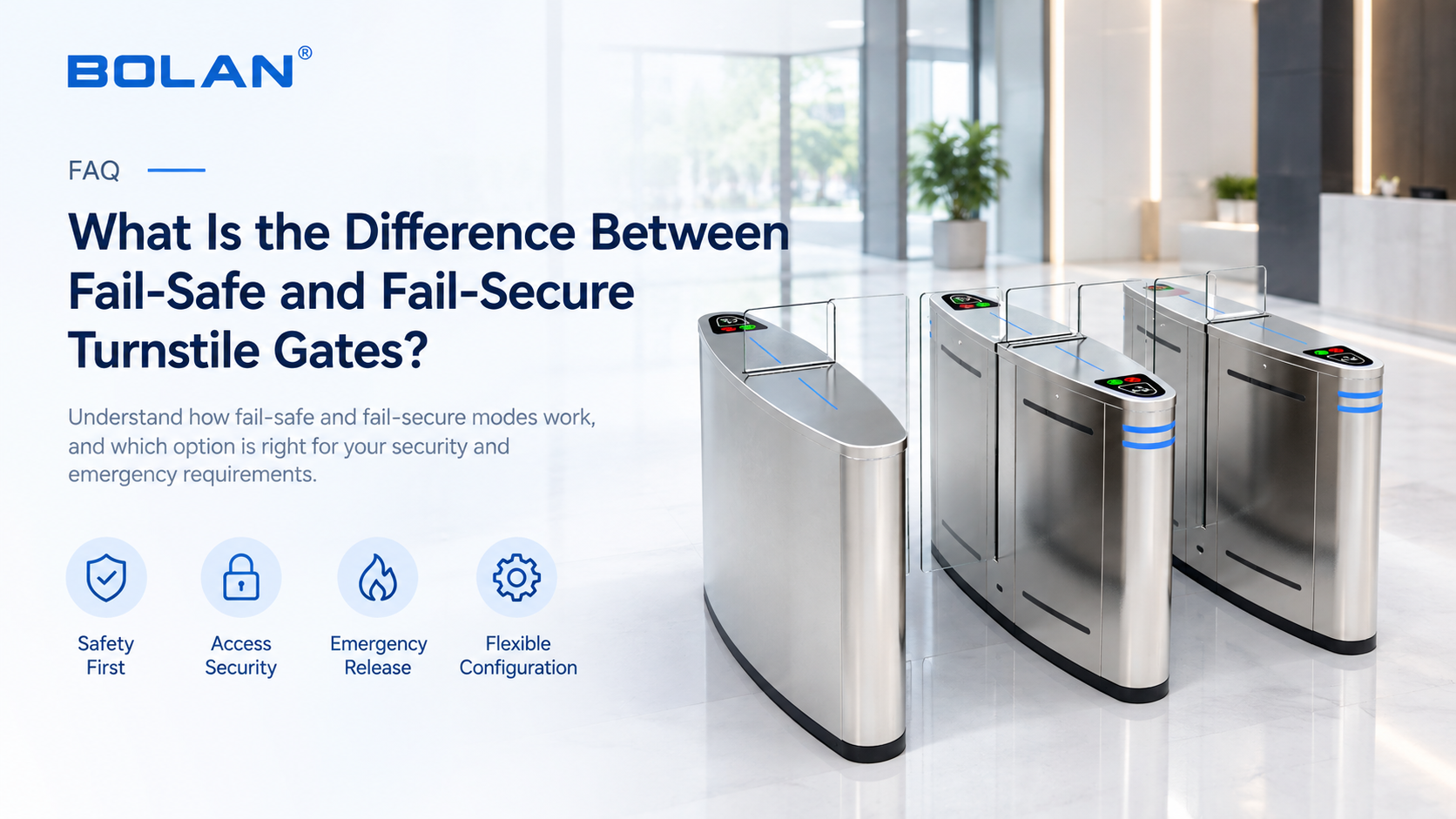
Fail-safe and fail-secure describe how a turnstile gate is configured to respond when power is lost or an emergency condition occurs.
Fail-safe operation prioritizes life safety. When power is interrupted or an emergency release signal is activated, the turnstile can release or unlock the passage to support evacuation and emergency access.
Fail-secure operation prioritizes access security. When power is lost, the turnstile remains locked to help prevent unauthorized entry into a restricted area. Emergency exit requirements may still be handled through a separate emergency release or fire-alarm interface.
The appropriate configuration depends on the turnstile type, application, security requirements, fire-safety strategy, local regulations, and access-control system.
BOLAN turnstile gates can be configured for different emergency and security requirements across product types, including tripod turnstiles, speed gates, swing gates, sliding gates, and full-height turnstiles. OEM/ODM configurations can also be evaluated for emergency release logic, fire-alarm integration, and power-failure behavior.
For a specific project, the required fail-safe or fail-secure configuration should be confirmed before production and installation.
Full-height turnstiles are designed for high-security, controlled pedestrian access and are generally not intended to serve as the accessible route themselves. For projects requiring ADA or other accessible entry, a common solution is to combine the full-height turnstile with a dedicated accessible swing gate or wider pedestrian gate.
In this configuration, the full-height turnstile controls standard pedestrian traffic, while the adjacent accessible gate provides a wider, more convenient passage for wheelchair users, people using mobility aids, delivery carts, and other users who require additional clearance.
BOLAN offers solutions such as the BLS-FH65 Full-Height Combo Gate, which combines a full-height security lane with an adjacent wide-access gate in one integrated entrance solution.
The accessible gate can be connected to the same access-control system as the turnstile, allowing controlled entry through RFID, QR codes, biometric readers, facial recognition, or other authorized credentials, depending on the project configuration.
For U.S. projects, the final accessible route, clear opening, reader position, gate operation, and surrounding installation should be reviewed against the applicable ADA Standards and local building/accessibility requirements.

BOLAN full height turnstile gates can integrate with a wide range of access control and identification systems, including RFID cards, NFC, QR/barcode scanners, fingerprint and biometric readers, facial recognition, mobile credentials, time attendance systems, and third-party access control platforms.
The turnstile works as the physical access barrier, while the connected system verifies the user's credentials and sends an authorization signal to release the turnstile.
For OEM/ODM projects, BOLAN can also customize the access control interface, reader mounting, and control logic according to the existing system and project requirements.

Yes. BOLAN full height turnstile gates can be configured for outdoor and harsh environments, including rain, dust, humidity, UV exposure, and temperature changes.
Depending on the model and application, options include 304/316 stainless steel and higher IP protection, such as IP54–IP65+ or specific higher-rated configurations. For coastal or highly corrosive environments, 316 stainless steel and higher IP protection can be specified.
For demanding outdoor projects, the appropriate material, IP rating, drainage, electrical protection, and operating-temperature range should be selected according to the local environment and installation conditions.

The required installation space depends on the tripod turnstile model, lane width, and site layout. Generally, the space should accommodate the turnstile footprint plus sufficient clearance for pedestrian access, arm movement, maintenance, and emergency passage.
For standard installations, BOLAN can provide the product dimensions and recommended layout drawings for the selected model. For projects with limited space, custom mounting or layout options can also be evaluated.
The final installation space should be confirmed based on the specific model and actual site conditions before installation.

Yes. Bolan Security offers single-lane, dual-lane, and multi-lane full height turnstile configurations for different pedestrian flow, site layout, and security requirements.
Our full height turnstiles can be configured as:
- Single-lane full height turnstile – suitable for factories, warehouses, restricted areas, construction sites, and other locations with standard pedestrian traffic.
- Dual-lane full height turnstile – provides two independent pedestrian lanes in one compact installation area, making it suitable for higher-traffic entrances and facilities that require separate entry and exit control.
- Multi-lane full height turnstile systems – multiple lanes can be combined to increase pedestrian throughput at stadiums, transportation facilities, industrial parks, large factories, and other high-flow sites.
Bolan models such as the BLS-FH53D, BLS-FH58D, and BLS-FH62D are available in dual-lane configurations, while multi-lane solutions can be customized according to the required pedestrian capacity and installation layout.
For projects requiring both high security and accessible passage, Bolan can also provide configurations combining standard full height turnstile lanes with a wider accessible lane. For example, the BLS-FH65 Full-Height Combo Gate combines a full height turnstile with an adjacent wide access door for wheelchair users and large carts.
The recommended number of lanes depends on several factors, including:
- Expected peak-hour pedestrian traffic
- Required entry and exit capacity
- Available installation space
- Security level and access control requirements
- Whether separate entry and exit lanes are required
- Accessibility requirements
As an OEM and ODM full height turnstile manufacturer, Bolan can customize the number of lanes, passage width, materials, access control integration, appearance, and other specifications according to your project requirements.
For high-security applications, our full height turnstiles provide full-height anti-climb protection and help reduce unauthorized entry and tailgating by creating a controlled one-person-per-cycle passage.
| Configuration | Recommended For | Main Advantage |
|---|---|---|
| Single Lane | Factories, warehouses, restricted areas | Compact and secure |
| Dual Lane | High-traffic entrances, separate entry/exit | Higher throughput |
| Multi-Lane | Stadiums, transportation hubs, large facilities | High-capacity pedestrian flow |
| Full Height + Accessible Lane | Stadiums, factories, public facilities | Security + accessible passage |

A standard single-lane full height turnstile typically requires 2–4 hours per unit for mechanical installation and basic commissioning when handled by a trained 2–3 person installation team. A fully prepared site can therefore allow one unit to be installed and tested within a working day.
The actual installation time depends on the equipment configuration and site conditions. A typical installation includes positioning and alignment, structural assembly, ground anchoring, electrical connection, access control integration, and functional testing.
Installation may take longer when the project involves dual-lane or multi-lane configurations, customized dimensions, additional access-control devices, complex cable routing, foundation work, or outdoor drainage and weather-protection requirements.
Before installation, the concrete foundation should be level and sufficiently strong, while power, grounding, cable routes, and access control equipment should be prepared according to the approved installation layout.
BOLAN provides installation documentation and technical support for full height turnstile projects, helping installers and system integrators complete assembly, wiring, commissioning, and troubleshooting efficiently.
